
On This Day in Wembury – 13 September 1832
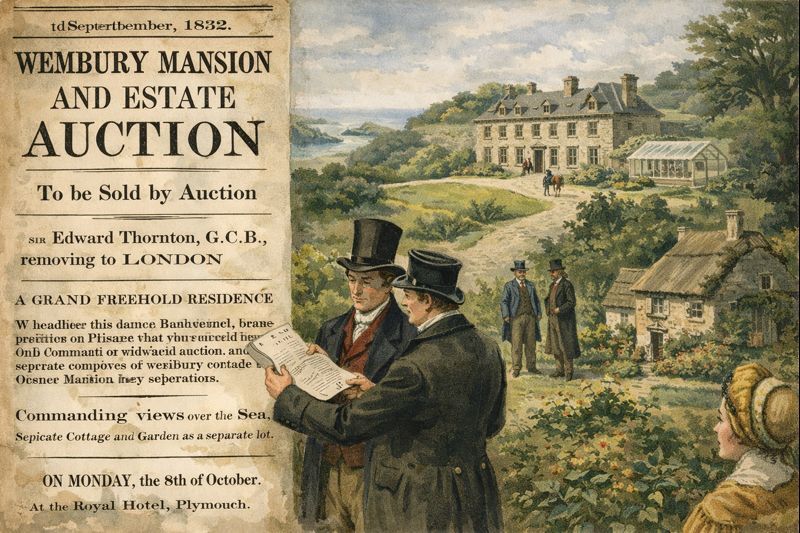
Wembury Mansion and Estate Auction Notice
The Bath Chronicle and Weekly Gazette carried an announcement of the forthcoming sale of a grand freehold residence at Wembury, the property of Sir Edward Thornton, G.C.B., who was removing to London. The estate comprised an elegant mansion with ten bedchambers, fine reception rooms, library, domestic offices, and extensive stabling for ten horses. Surrounded by lawns, paddocks, plantations, greenhouses, and productive gardens, the house commanded sweeping views over the sea and the wooded banks of the River Yealm. In total, the grounds covered about 30 acres, with a separate cottage and garden offered as a second lot. The auction was scheduled for 8 October at the Royal Hotel, Plymouth.
This sale illustrates how, even in the early 19th century, Wembury attracted families of rank and fortune, its coastal scenery and fertile land making it desirable to men like Sir Edward Thornton. From medieval manorial sales to Victorian estate dispersals, the history of Wembury House and its neighbours has often mirrored the ebb and flow of national wealth and politics.
On This Day in Wembury — 13 September 1932
A Harbour for the Yealm, and a Battle Over an Ancient Right of Way
On 13 September 1932, the Western Morning News published a letter from W. F. Bensted-Smith of Gara, Newton Ferrers, raising two issues which clearly mattered to people living on both sides of the River Yealm.
Bensted-Smith began by expressing what he described as the “general pleasure” of residents at the prospect of a proper harbour authority for the Yealm. But his main concern was something much more immediate: an old public route beside the river which he believed was in danger of disappearing.
He drew the attention of Plympton Rural District Council to what he called the “keen resentment” caused by the removal of a public right of way along the foreshore opposite the old Coastguard Station.
The path had apparently been blocked and undermined and then removed altogether. This was particularly important because the spot had long been used by yachts and houseboats landing on that side of the river. In southerly gales, Bensted-Smith wrote, it was often the only safe place where they could land.
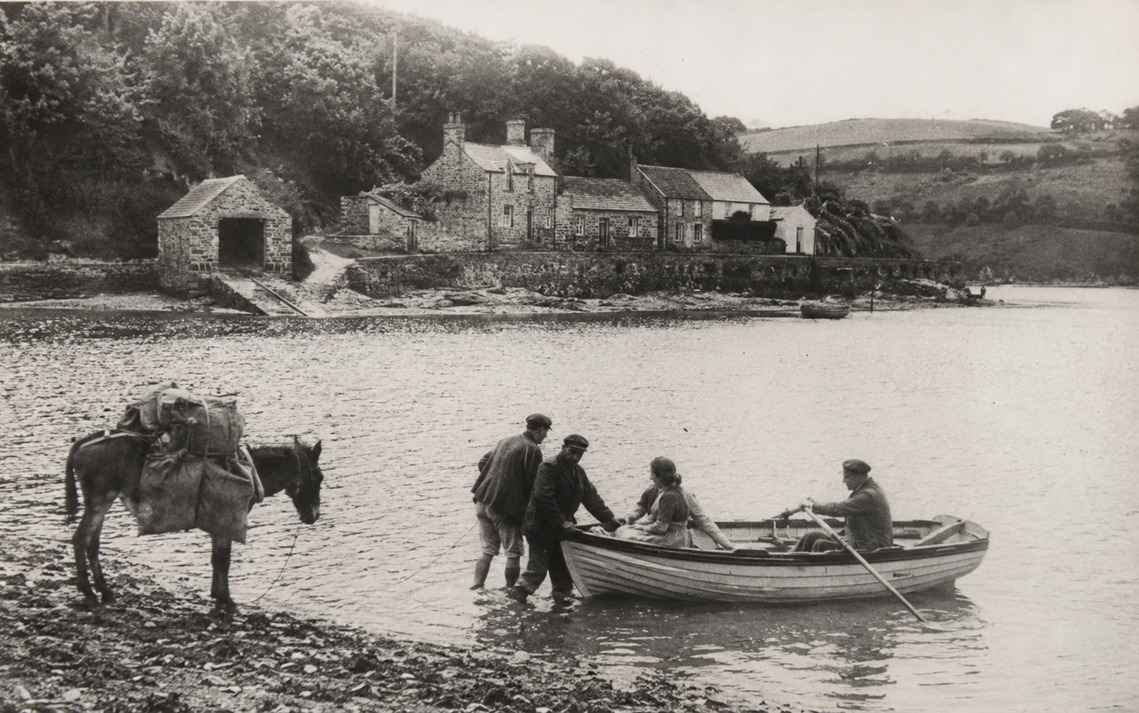
His argument was not simply about convenience. He claimed the right of way was of “very ancient origin”, dating back to the days when pack donkeys were brought down to the river and ferried across to the Wembury side.
The loss of the route was already causing practical difficulties. That very morning, he said, a patient who needed to be taken by ambulance to Plymouth could not simply be rowed ashore. Instead she had to be carried up an easy slope, then endure “a long wet pull against a flood tide and a strong wind”, before finally being carried up the steep steps at Newton Creek.
It is a wonderful little glimpse of life around the Yealm before modern roads and easy transport connections. The river was not merely scenery. It was a highway, a workplace and sometimes the quickest route to medical help.
And perhaps the most intriguing detail is the reference to those pack donkeys being ferried across to Wembury. It hints at a much older network of tracks and crossings around the Yealm, surviving in local memory long after the animals themselves had disappeared.
Reflection: Nearly a century later, arguments about access to the coast and the preservation of old rights of way still feel remarkably familiar. Paths which can look insignificant on a map may carry centuries of local history. Once they disappear, we lose not only a way of getting from one place to another, but part of the story of how people once lived around the Yealm.
Entries are summaries and interpretations of historical newspaper reports.