
On This Day in Wembury — 14 September 1860
A Naval Shell Lands Among Wembury Farm Workers
On 14 September 1860, the Royal Cornwall Gazette reported a frightening reminder that living beside one of Britain's great naval harbours occasionally had its drawbacks.
A Government gunboat was carrying out firing practice in Plymouth Sound. The crew were using heavy 68 pounder and 32 pounder guns, firing towards an object lying in the water roughly between the eastern end of Plymouth Breakwater and the Mewstone.
Something went badly wrong.
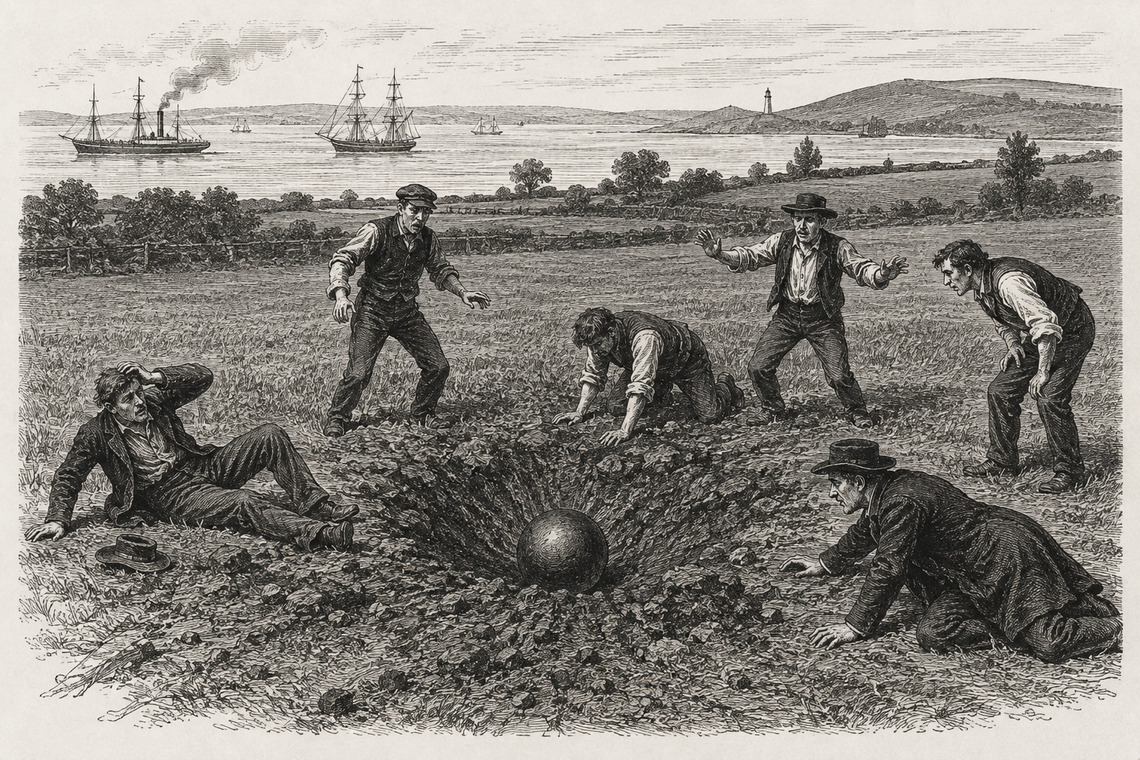
One 68 pounder shot dropped alarmingly close to a group of men, while a 32 pounder went considerably farther than intended. It crossed the water towards Wembury and ploughed into a field where a farmer named Lunn and his men were working.
The impact was dramatic. Lunn and his labourers were knocked down and showered with earth as the enormous projectile buried itself in the ground.
Remarkably, nobody appears to have been seriously injured.
Lunn subsequently dug out part of the shell and carried it home with him, presumably acquiring one of the more unusual Victorian ornaments ever to grace a Wembury farmhouse.
There is an intriguing mystery here. I have not yet been able to identify farmer Lunn with sufficient confidence to put a Christian name to him, nor therefore establish exactly which Wembury farm and field were involved. Contemporary naval records do, however, confirm that several warships and gun vessels were at Plymouth at precisely this time.
It is an extraordinary little Wembury story. A farmer and his men quietly going about their work, while several miles away the Royal Navy practised with some of the most powerful guns of the day, and suddenly a naval shell comes hurtling into their field.
Reflection: Today the sounds drifting across Plymouth Sound are familiar enough to anyone living in Wembury. But in September 1860, one farmer discovered rather dramatically that what happened out in the Sound did not necessarily stay there. Somewhere beneath one of Wembury's fields, there may even still be fragments of that errant shell.
On This Day in Wembury — 14 September 1909
Council Challenge Over Wembury Dock Scheme
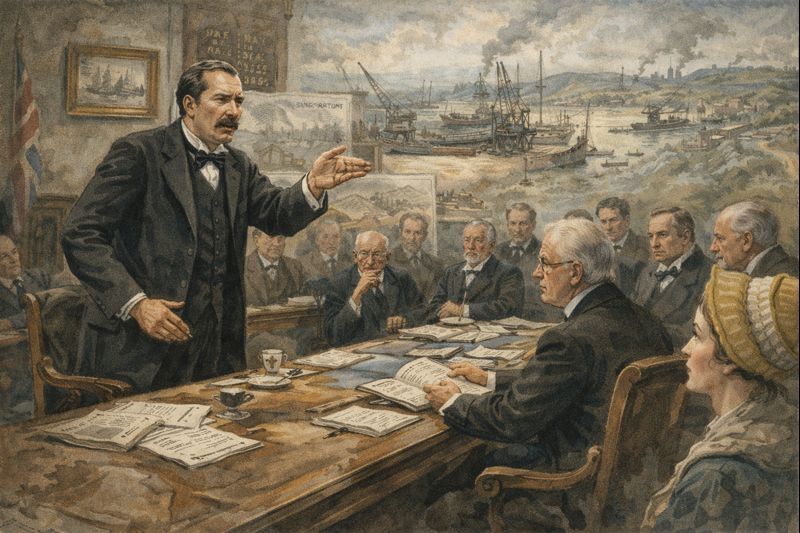
At a Plymouth Borough Council meeting on this day, Mr. Pengelly questioned whether the Council had been legally constituted to discuss a Special Committee’s minutes regarding the Wembury Dock scheme held the previous May, arguing that there had not been a quorum present. The Town Clerk, however, ruled that in his judgment the Council had been properly constituted and its proceedings valid.
Context:
The proposed Wembury Dock scheme had dominated local affairs in the late 19th and early 20th centuries. Plans envisioned turning Wembury Bay into a vast harbour to rival Southampton or Liverpool, involving reclamation of land, new rail links, and massive changes to the coastline. For Plymouth’s established dock and mercantile interests, such a project was both a threat and a challenge. The debate repeatedly spilled into council chambers, with supporters arguing it would bring prosperity and critics warning it would disrupt established trade, damage fishing, and alter the very character of Wembury.
Reflection:
By 1909, the scheme had already been weakened by financial difficulties and shifting priorities, yet the issue still surfaced in disputes such as this. For Wembury villagers, the dock plan had been a cloud over their community for decades—raising fears of losing farmland, beaches, and the parish’s rural identity. The council wrangles in Plymouth reflected wider tensions between ambitious industrial schemes and the preservation of South Devon’s coastline.
Source: Western Morning News, 14 September 1909
Entries are summaries and interpretations of historical newspaper reports.