
On This Day in Wembury — 1 December 1834
Wembury wheat astonishes the botanists
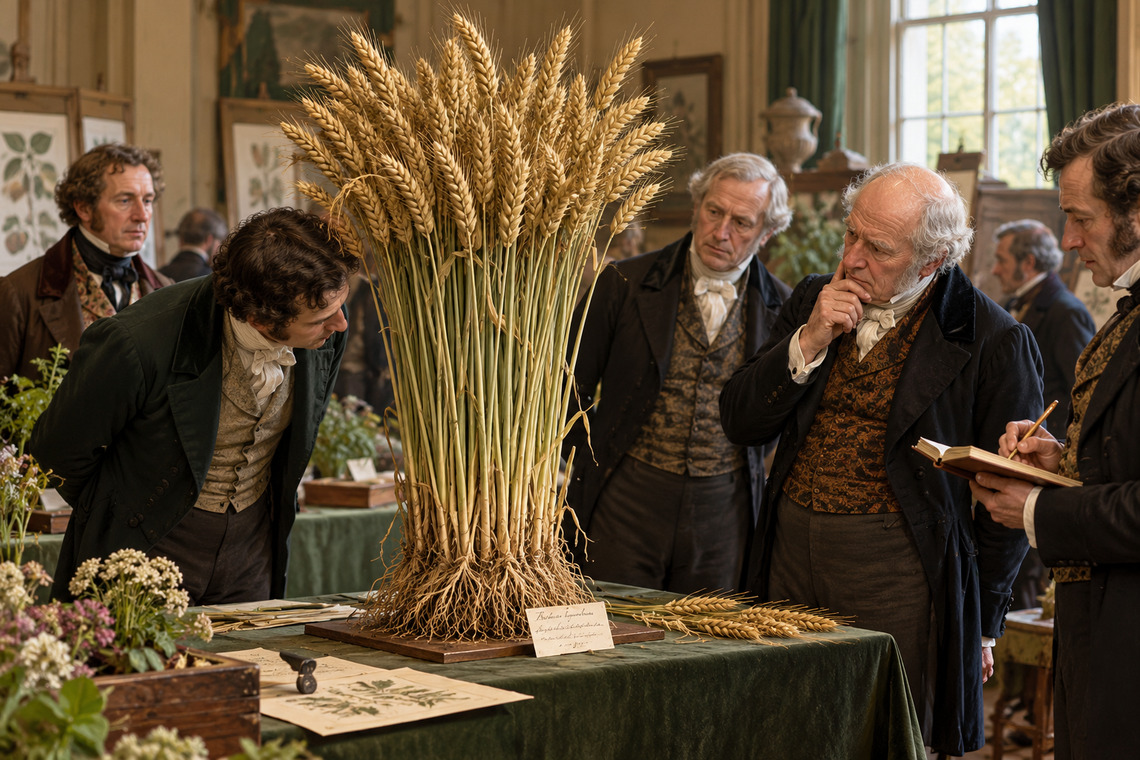
On 1 December 1834, The Gardener’s Magazine carried an account of a meeting of the Royal Devon and Cornwall Botanical and Horticultural Society at which an extraordinary specimen of wheat from Wembury attracted particular attention.
The plant had been sent for exhibition by Sir Edward Thornton, who was then associated with Wembury House.
It was described as “Victoria wheat” and was remarkable for the number of stems growing from a single root. The report said that between twenty and thirty stems had developed, all carrying well-formed ears of wheat.
Even more astonishing was the claimed speed of its growth.
According to the exhibition ticket, the wheat had been sown on 27 April and was already in ear by the time it was shown on 22 May — only about twenty-five days later.
The plant was also said to have reached an extraordinary height, with some stems around three feet and others approaching four feet.
Other impressive wheat specimens were displayed at the meeting, but the writer considered Thornton’s Wembury example exceptional both for its size and for the remarkably short period in which it was said to have grown.
There was, however, a note of scientific caution. Rather than immediately accept such extraordinary growth at face value, the magazine suggested that the variety deserved a proper trial before firm conclusions were drawn.
That caution is revealing. The early nineteenth century was a period of intense interest in agricultural improvement, with landowners and horticultural societies constantly experimenting with new varieties of crops, better cultivation methods and plants brought from elsewhere.
Sir Edward Thornton’s specimen places Wembury directly within that culture of experimentation.
At a time when the parish was overwhelmingly agricultural, an unusually vigorous wheat plant was not merely a curiosity. A variety capable of producing many stems from one root and reaching maturity quickly could potentially mean better yields and greater profit.
Whether the celebrated Wembury specimen ever fulfilled those hopes is less important than the moment itself.
In 1834, a single wheat plant grown at Wembury was impressive enough to make the pages of one of Britain’s leading gardening publications and leave experienced horticulturalists wondering quite what they were looking at.
Source: The Gardener’s Magazine, 1 December 1834; report of the Royal Devon and Cornwall Botanical and Horticultural Society.
On This Day in Wembury
1 December 1952 — Wembury Beat the League Leaders
The Western Morning News reported a notable upset in local football: Wembury defeated Borringdon Athletic 2–1, handing the Premier Division leaders their first loss of the season.
Wembury struck first when C. Spencer set up Roach with a fierce drive that left the keeper no chance. Although Borringdon equalised through Harris, Wembury regained the lead before half-time after Roach fumbled a shot from Congdon, allowing Spencer to pounce and score. Despite heavy second-half pressure from Borringdon, Wembury’s defence held firm, with Hopper outstanding at centre-half and Congdon supplying chances from the wing.
This match is a reminder of Wembury’s long footballing tradition. The village club, known later as Wembury United, played in red and white stripes and remained active until around the early 2000s, competing in the Plymouth & District leagues.
Source: Western Morning News, 1 December 1952.

Entries are summaries and interpretations of historical newspaper reports.