
On This Day in Wembury — 6 December 1824
Three hours clinging to the wreck at Wembury
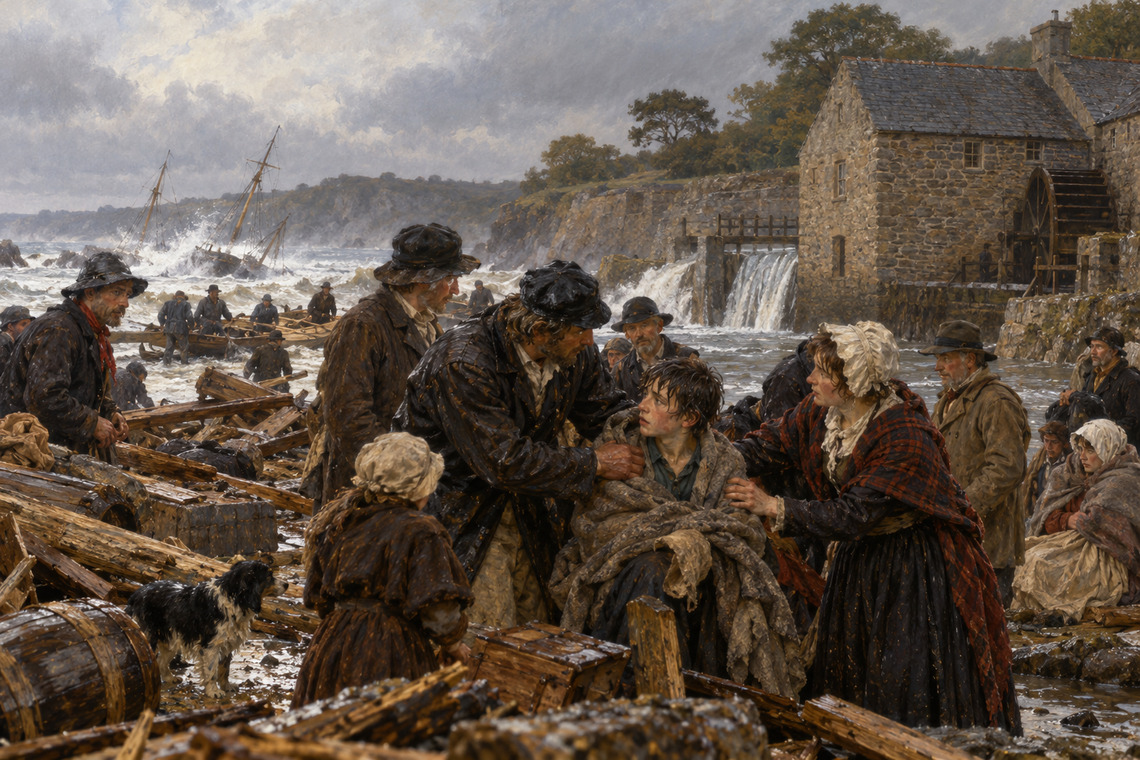
On 6 December 1824, the Morning Post published a dramatic account of the great storm which had devastated the Plymouth coast two weeks earlier, including the wreck of the John at Wembury.
The John, commanded by Captain Wills, had been sailing from Leghorn to London with a mixed cargo when she was driven ashore near Wembury during the violent storm of 22–23 November.
Captain Wills had his wife with him. She had spent the previous two years in the Mediterranean in the hope that the warmer climate would improve her health.
During the night, with conditions steadily worsening, Captain Wills examined his chart and told her:
“Dear Betsey, I am afraid this will be a fatal night for us.”
Her answer was remarkably calm:
“Do your duty, my dear, and do not think of me.”
Soon afterwards Mrs Wills heard a tremendous crash.
The ship had struck.
Water began rising inside the cabin and, lightly dressed and already in poor health, she made her way on deck. There she found the vessel being overwhelmed by the sea, with wreckage and rigging already being torn away.
In complete darkness, with waves breaking over the ship, she managed to reach the stern and seize one of its stanchions.
There she remained.
For more than three hours, Mrs Wills clung to the wreck while the storm continued around her.
The Morning Post was clearly astonished by her survival, describing her as a woman of delicate health whose courage seemed completely at odds with her physical condition.
Elsewhere in the same storm, wrecks were reported all around Plymouth and the South Devon coast. At Wembury, another vessel, the Welcome, from the Canary Islands, was also driven ashore, while Wembury Mill suffered severe damage as the sea swept across the beach.
The destruction caused by the storm of November 1824 became one of the most memorable maritime disasters in the area’s history.
But within all the reports of lost ships, scattered cargoes and drowned sailors, the story of Mrs Wills stands out.
A woman who had travelled abroad because of fragile health survived one of the fiercest storms ever recorded on the South Devon coast by holding onto a wrecked ship in darkness for three hours.
Sometimes local history survives in dates and statistics.
Sometimes it survives in one extraordinary human story.
Source: Morning Post, Monday 6 December 1824.
On This Day in Wembury — 6 December 1895
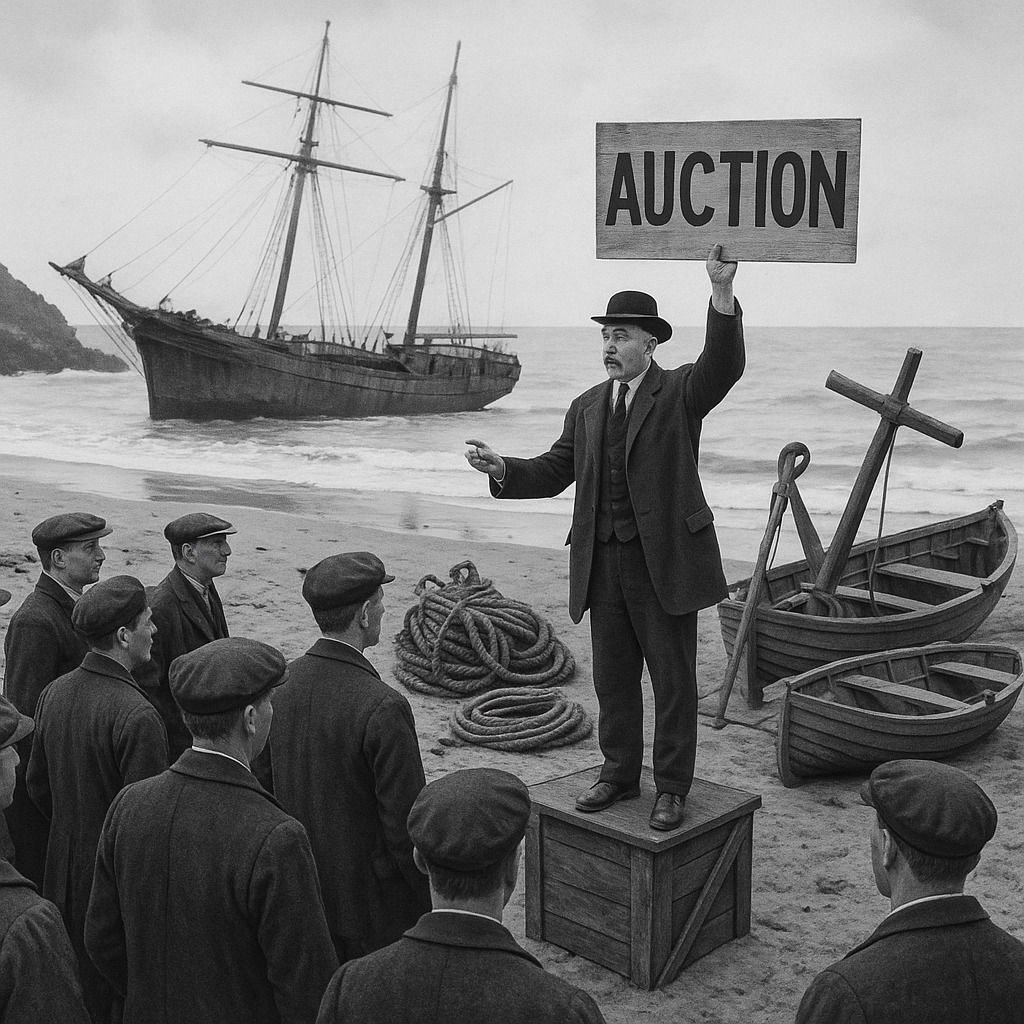
On this day the hull of the Norwegian barque August Smith was sold by auction on Wembury Beach. The sale was carried out by Skardon and Sons of Plymouth at low tide. In addition to the wreck itself, cables, anchors, boats and spars were offered in lots. The vendors reserved the right to salvage the cargo and to use some spars and tackle while that work was underway. A special conveyance was arranged from Plymouth to bring prospective buyers to the auction site.
The August Smith had been wrecked on the Wembury coast only days earlier. In the nineteenth century such sales were common after strandings, with local people gathering to watch as vessels were stripped, sold and broken up. The cargo and materials were valuable, and salvage law allowed recovery while also permitting sales of hulls and fittings. The auction at Wembury reflected the practical and sometimes dramatic aftermath of shipwrecks on the South Devon coast.
Source Western Morning News, 6 December 1895
Entries are summaries and interpretations of historical newspaper reports.