
On This Day in Wembury — 12 December 1890
The Nepaul wrecked off Wembury in dense fog
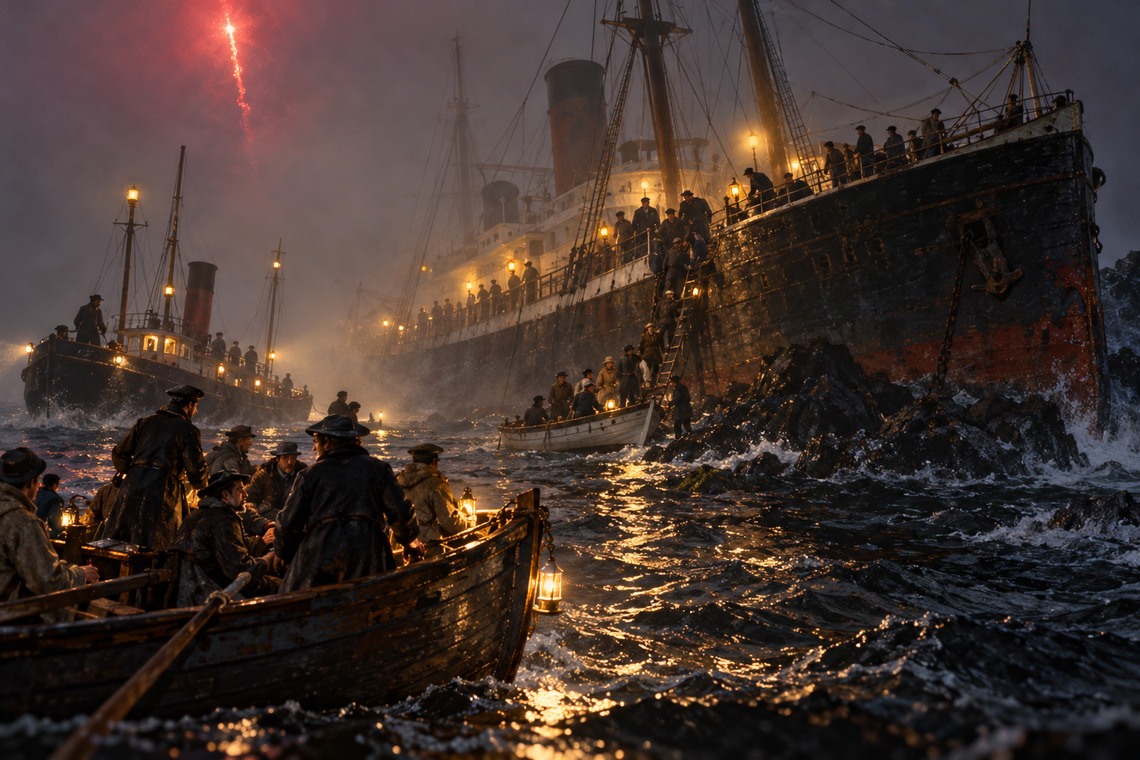
On 12 December 1890, the Western Morning News carried a detailed account of the wreck of the P&O steamship Nepaul, which had gone ashore two nights earlier on the reef near the Shagstone, outside Plymouth Sound.
The Nepaul was a substantial iron steamship, built in Glasgow in 1876 and measuring about 375 feet long. She was returning from Calcutta, having called at Colombo, Aden, Suez, Port Said and Marseilles, and was bound for Plymouth and then London. Her cargo included large quantities of tea, rice, wheat, indigo, jute, specie and general merchandise.
On the evening of 10 December 1890, the ship approached Plymouth in increasingly thick fog. The Eddystone light had been seen earlier, but the Nepaul failed to pick up a pilot and continued towards the Sound.
By about 7.20 p.m., the officers were trying to make sense of the few lights visible through the mist.
The ship then struck.
The impact was not especially violent at first. Contemporary accounts say that many aboard barely felt the initial contact, but the vessel had run onto a jagged reef close to the Shagstone, tearing open her bottom and leaving her firmly stranded. Modern archaeological work places the wreck on a shallow reef just south of the Shagstone rather than actually on the rock itself.
Captain George Westrop Brady immediately had soundings taken around the ship. Pumps were started, watertight doors closed and preparations made to lower the boats.
Rocket signals were sent up into the fog.
Those signals brought a rapid response from Plymouth. Government and harbour craft, including tugs, pilot boats and other vessels, made their way towards the stranded liner, while news of the accident reached Admiralty House.
The passengers were taken off safely, and there were no fatalities.
The Western Morning News also described some confusion among the crew during the evacuation. Some of the Lascar sailors initially began gathering their personal belongings rather than immediately assisting with the boats, but officers intervened and order was restored. Other seamen aboard the ship, including men from another recently wrecked vessel, were praised for helping with the emergency.
The situation was made even more remarkable by another casualty nearby.
The trawler Baroda, trying to find her way into Plymouth in the same dense fog, also ran aground that night and was later carried into Wembury Bay. The SHIPS Project records that the Baroda grounded within about 100 yards of the Nepaul, apparently after following what she assumed was a safe course into the harbour.
By daylight, the scale of the damage to the Nepaul became clear.
The rocks had penetrated her bottom, and with the vessel firmly lodged on the reef there was little realistic prospect of refloating her. There was particular concern about the large quantity of rice aboard: once soaked in seawater it could swell, placing even greater pressure on the hull.
Crowds soon began travelling out by both land and sea to see the wreck.
The Nepaul was already one of P&O’s older ships, and although she had completed many long-distance voyages between Britain and India, this accident brought her career to an abrupt end. Salvage work followed, and much of the cargo and equipment was later recovered and sold.
The official inquiry subsequently held Captain Brady responsible for the navigation leading up to the grounding and suspended his master’s certificate for six months.
Today the remains of the Nepaul lie scattered across the seabed south of the Shagstone, mixed among the remains of other wrecks and later debris. Divers can still find sections of her heavy iron hull, fittings and occasional smaller objects bearing the P&O crest.
The wreck is a reminder of just how treacherous the approaches to Plymouth could be before radar, radio navigation and modern harbour aids.
A ship that had crossed thousands of miles from India, passed safely through the Suez Canal and Mediterranean, and reached the final few miles of its voyage was lost almost within sight of its destination.
And in the same fog, another vessel ended up in Wembury Bay.
Source: Western Morning News, Friday 12 December 1890.
Supporting context: SHIPS Project records for the Nepaul and Baroda; P&O wreck records; Board of Trade inquiry references.
On This Day in Wembury
12 December 1908 — World’s Largest Dock Proposed for Wembury Bay
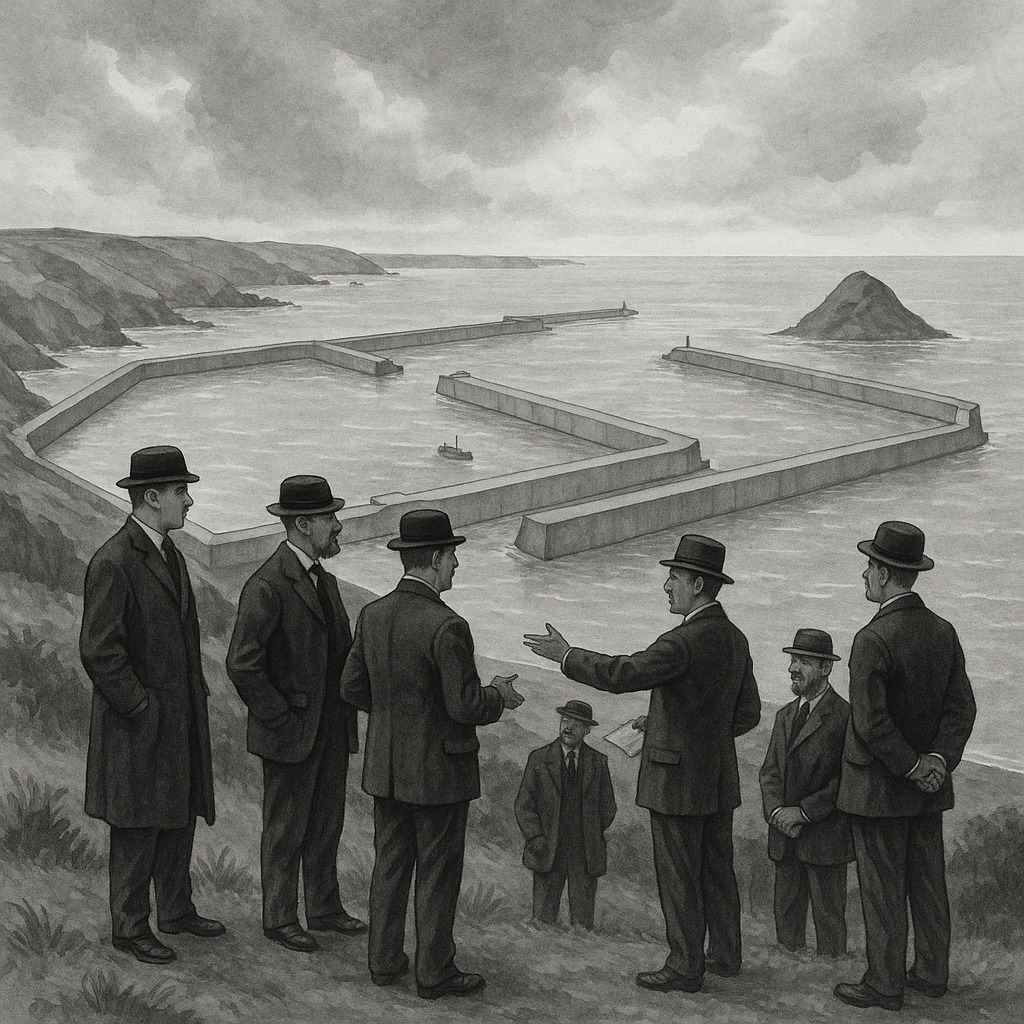
The Totnes Weekly Times reported on a visit by commercial leaders and public officials to Wembury Bay, where it was proposed to construct what was described as the largest dock in the world.
The plan envisaged enclosing over 1,000 acres of sea with vast breakwaters stretching from Wembury Point to the Mewstone, then seawards and across from Gara Point. An inner harbour of 255 acres, with seven miles of quay space, wharves, piers, and two graving docks up to 1,100 feet long, would have accommodated the largest liners afloat. The total cost was estimated between £1.75 and £2 million, with a railway spur to Plymouth at an additional £150,000.
Had it gone ahead, Wembury would have been transformed into a global ocean gateway, eclipsing even Liverpool or Southampton in scale. The tranquil bay, dominated by the church and the Mewstone, would have become a hub of international shipping and heavy industry.
In reality, the scheme never advanced beyond the planning and publicity stage. Admiralty objections, environmental challenges, and shifting commercial priorities meant the project was quietly shelved. Instead of becoming a dockyard city, Wembury remained a rural parish and beauty spot, later secured by the National Trust for conservation.
Source: Totnes Weekly Times, 12 December 1908.
Entries are summaries and interpretations of historical newspaper reports.