
On This Day in Wembury — 22 December 1930
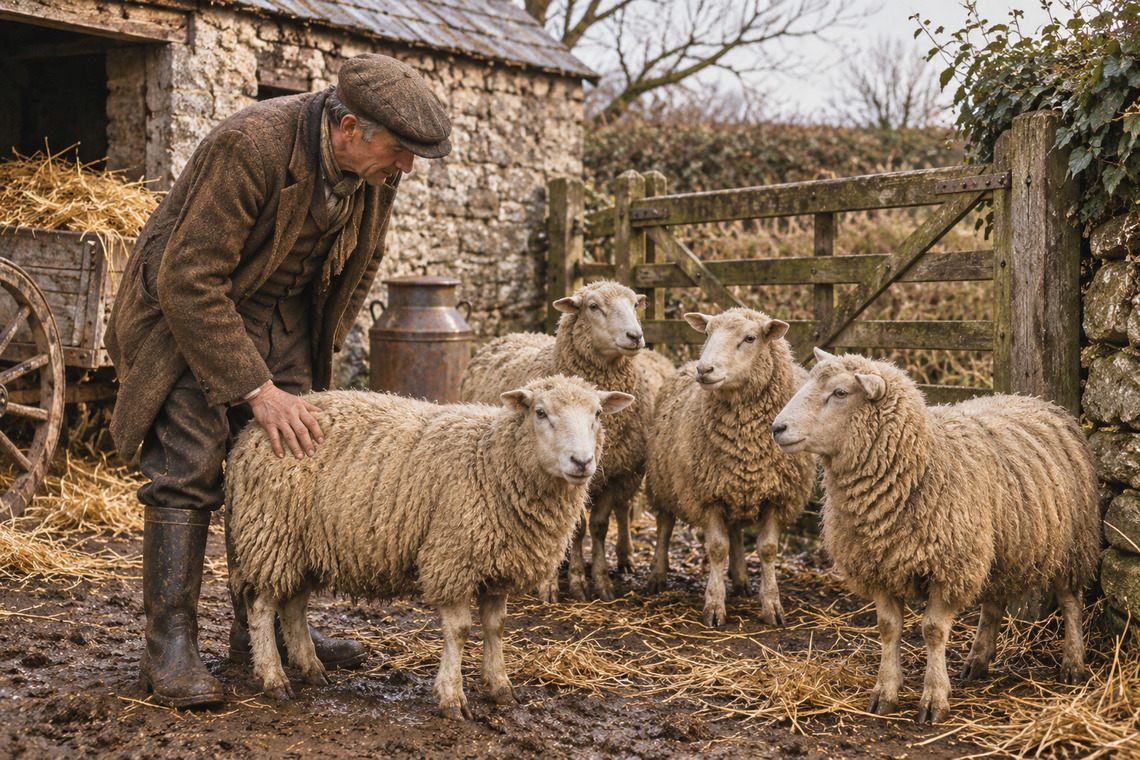
Four stray ewes turn up at Spirewell Farm
On 22 December 1930, the Western Morning News carried a tiny notice from Wembury:
“Four ewes strayed on Spirewell Farm, Wembury, December 10th. Owner can have same on paying expenses.”
It was only a few lines, but it gives a wonderfully ordinary glimpse of rural Wembury between the wars.
The four sheep had apparently wandered onto Spirewell Farm on 10 December and were still there nearly two weeks later. Rather than simply turn them loose again, the finder had kept them safe and advertised publicly for their owner.
Whoever eventually claimed them would be expected to pay the costs of their keep.
At this date Spirewell was still very much a working farm. It had formed part of the Langdon Estate until the estate was broken up in 1927, and local history records that Ernest Reid, who had been occupying the farm, bought it at that sale.
The farm lay among a patchwork of fields, hedges and lanes where sheep and cattle were routinely moved between grazing. A damaged hedge, an open gate or animals simply finding their way through a gap could quickly leave livestock several fields away from where they belonged.
Four missing ewes would have represented real value to their owner, particularly in December when grazing was poorer and farmers were already providing winter feed.
The wording of the advertisement also shows how rural communities dealt with such incidents before telephone ownership became widespread. A notice in the local newspaper could reach farmers across Wembury, Down Thomas, Knighton and the surrounding countryside far more effectively than searching from farm to farm.
There is something appealing about the simplicity of it.
Four sheep had gone wandering, somebody at Spirewell had taken responsibility for them, and somewhere nearby a farmer was presumably wondering where they had disappeared to.
Perhaps, just before Christmas 1930, opening the Western Morning News finally provided the answer.
Source: Western Morning News, Monday 22 December 1930.
Supporting context: Wembury Local History Society records of Spirewell Farm and the 1927 break-up of the Langdon Estate.
On this day in Wembury — 22 December 1994
The Plymouth Extra’s weekly property supplement carried a clutch of classified requests that capture the late-1994 market: one notice flagged “£42,000 – early decision available”; another said “Mrs L from Plymouth would like to buy a 3-bedroom home in Plymstock, Wembury or Heybrook Bay up to £80,000, to be settled by Easter”; and “Mr and Mrs N require a 3-bedroom bungalow in a level location for wheelchair access, preferably in Plymstock, Elburton or Wembury, up to £80,000, urgent purchase required in the New Year.” In simple CPI terms, £80,000 in 1994 is roughly £170,000–£190,000 today, yet coastal and village homes in Wembury and Heybrook Bay have risen far faster than inflation, with typical sales now several times that figure. The supplement itself was thick with agency pages and private ads in the pre-internet era; by contrast, the same demand today is funnelled almost entirely through online portals like Rightmove, with large scale weekly print advertising largely a thing of the past.
(Source: Plymouth Extra, 22 December 1994 — property wanted adverts.)

Entries are summaries and interpretations of historical newspaper reports.