
On This Day in Wembury, 8 September 1871
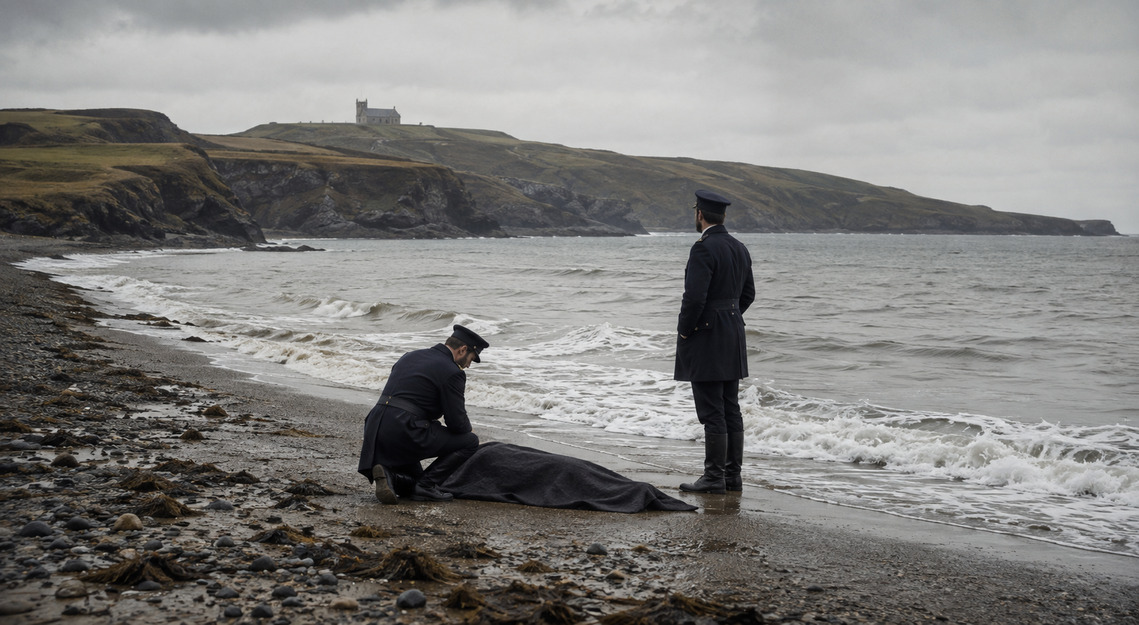
The unidentified man found on Wembury Beach
A grim discovery on Wembury Beach was reported across the country on 8 September 1871.
The body of a man had been washed ashore near Plymouth. It had evidently been in the sea for some time. The man’s face and part of one leg had been so badly damaged that recognition by appearance was impossible.
Searchers examined his clothing in the hope of discovering who he was. In one pocket they found a letter dated 9 August 1871. It had been written by his mother and referred to £30 which her son had sent to her.
That letter must initially have offered some hope that the mystery would soon be solved. Unfortunately, the newspaper report did not publish the woman’s name or address.
Further information appeared in the Western Morning News. An inquest had been held at Wembury on Friday 1 September by Mr Allan B Bone, the Devonport coroner. Among the man’s possessions was an almanack in which the name Edward Ellis had been written.
It therefore seems possible that the dead man was Edward Ellis. However, the name in the almanack was not considered sufficient proof of identity. It might have belonged to its owner, but it could equally have been the name of somebody else or simply a note written inside the book.
The jury returned a verdict of “Found Dead”. This is significant because the verdict did not name the man and did not even formally record that he had drowned. The condition of the body presumably made it impossible to determine exactly how or when he had died.
Despite the letter from his mother and the name Edward Ellis in the almanack, I have found no later report confirming his identity. Searches for an Edward Ellis connected with the case, with Wembury or with the place named in the letter have produced no reliable match.
The £30 mentioned in the letter was a large amount of money in 1871. It may suggest that the man had been working away from home, perhaps at sea, and had sent some of his earnings back to his mother. That remains speculation, but it provides a small glimpse of the life he might have led before his death.
There was another inquest at Ringmore at almost the same time after a second man was found on the coast. That body was identified as William Welsh, who had been lost from the yacht Minnie. The two cases were reported together, but they concerned different men. The body found at Wembury remained unidentified.
This short report leaves behind a particularly sad mystery. Somewhere a mother had received £30 from her son and had written to him in August 1871. Within weeks, a man carrying her letter was lying unidentified on Wembury Beach. Whether his name really was Edward Ellis, how he entered the sea and whether his mother ever discovered what had happened to him remain unknown.
Sources: Derbyshire and Chesterfield Reporter, Friday 8 September 1871. Western Morning News, Saturday 2 September 1871.
On This Day in Wembury – 8 September 1988
Job advertisements in the Western Evening Herald highlighted vacancies at Langdon Court, Wembury, then operating as a country house hotel. Positions advertised included a sous chef for a “high-class catering position” and an assistant manager/manageress role requiring broad hotel experience, initiative, and transport.
Though routine in appearance, such adverts capture Langdon Court’s life in the late 1980s, showing its continuing role as an upmarket hospitality venue and major local employer, decades after its transformation from historic manor into hotel.
Source: Western Evening Herald, 8 Sept 1988.

Entries are summaries and interpretations of historical newspaper reports.